


· By Cullen Mo
How to Choose the Best Konjac Jelly
Want to know if a konjac jelly is worth buying? Turn the bag around.
Here are 4 things we look for: what sweetens it, where the flavor comes from, how you eat it, and what the maker can tell you about the konjac itself.
We also make konjac jelly, so we're biased with our standards. These are the same checks we use on our own konjac jelly chews.
A lot of “best konjac jelly” lists are built around whatever brands happen to be popular when the article was written. Ingredient lists are more useful. Recipes change, brands change, and a list can sit online for years. The back of the bag is more useful for how you decide to purchase today.
Your Aisle Lookout List
If you're standing in the candy aisle, here's what to look for:
- Sweetener. Look for real sugar, such as beet or cane sugar. If you see corn syrup, high-fructose corn syrup, or a lot of sugar alcohols, those could raise caution.
- Flavor. Check whether the flavor comes from natural or artificial flavoring. This can vary from one flavor to another, even within the same brand.
- Format. Look at how the jelly is packaged and eaten. A soft chewable sachet is different from a firm jelly cup you swallow whole.
- Sourcing. See what the maker says about where its konjac comes from. A specific answer provides more information about sourcing than a vague answer.
What is Konjac Jelly?
Konjac jelly is made from a plant root rather than gelatin. The plant is Amorphophallus konjac, and its underground corm contains a water-soluble dietary fiber called glucomannan. Konjac corm is especially rich in glucomannan, which is one of the most viscous dietary fibers known.
That fiber is what gives konjac jelly its characteristic texture. The corm is processed into a fine flour, mixed with water, and the glucomannan forms a gel. Unlike a traditional gummy, konjac jelly doesn't need gelatin to set.
If you want the longer version, our what-is-konjac-candy pillar explains where konjac comes from and how it becomes candy. We also go deeper into the science of why it's so chewy.
For shopping purposes, the important thing is that the chew comes from the konjac's form.
Criterion 1 — How is it sweetened?
This is one of the first things we'd check. Konjac jelly can be sweetened with regular sugar, corn syrup, or sugar alcohols, and the front of the package doesn't always make that clear. The ingredient list does.
Corn syrup and high-fructose corn syrup
Corn syrup is an inexpensive bulk sweetener. High-fructose corn syrup is corn syrup with some of its glucose converted to fructose.
Neither is uniquely dangerous, and HFCS and table sugar have roughly similar metabolic effects. The question for us is more straightforward: if you're choosing a candy, do you want it sweetened with a bulk sweetener that adds sugar without much else?
Added sugars provide calories without many other nutrients, as Harvard Health explains.
We chose beet sugar instead. If you're curious why, we explain the choice in corn syrup vs. beet sugar.
Sugar alcohols
“Zero sugar” can look pretty appealing on a candy package. Before taking that at face value, check what's providing the sweetness.
Maltitol and sorbitol are common sugar alcohols in sugar-free candy. They can be hard on the stomach, especially in larger amounts. Sorbitol has a relatively low tolerance; one study put its laxative threshold at about 0.17 g/kg of body weight.
Maltitol is also only partly absorbed. The rest reaches the colon, where it is fermented, which can mean gas and bloating. Erythritol tends to be better tolerated because most of it is absorbed in the small intestine.
The amount matters, too. A little may not bother you, while a larger serving can be another story. The EU requires foods containing more than 10% added polyols to carry a warning about possible laxative effects. We go into more detail in our guide to sugar alcohol side effects.
Real sugar
This is the route we chose.
We use beet sugar, so our nutrition panel shows a few grams of sugar rather than a “0g” claim. It's still sugar, and we're fine saying that. For us, a small amount of regular sugar makes more sense than replacing it with a large amount of sugar alcohol.
Criterion 2 — Where does the flavor come from?
Next, look at the flavoring.
Under FDA labeling rules, “natural flavor” means the flavoring comes from a natural source, such as a fruit, spice, root, or leaf. “Artificial flavor” means the flavoring substance does not come from those sources.
These terms tell you where the flavoring came from. They don't tell you that one is automatically healthier or that the other is unsafe. A flavor made from a natural source can still contain highly refined compounds, while an artificial flavor can be chemically identical to a compound found in fruit.
It's also worth checking the individual flavor rather than assuming the whole brand uses the same recipe. Recipes change over time, and different flavors can be reformulated at different points.
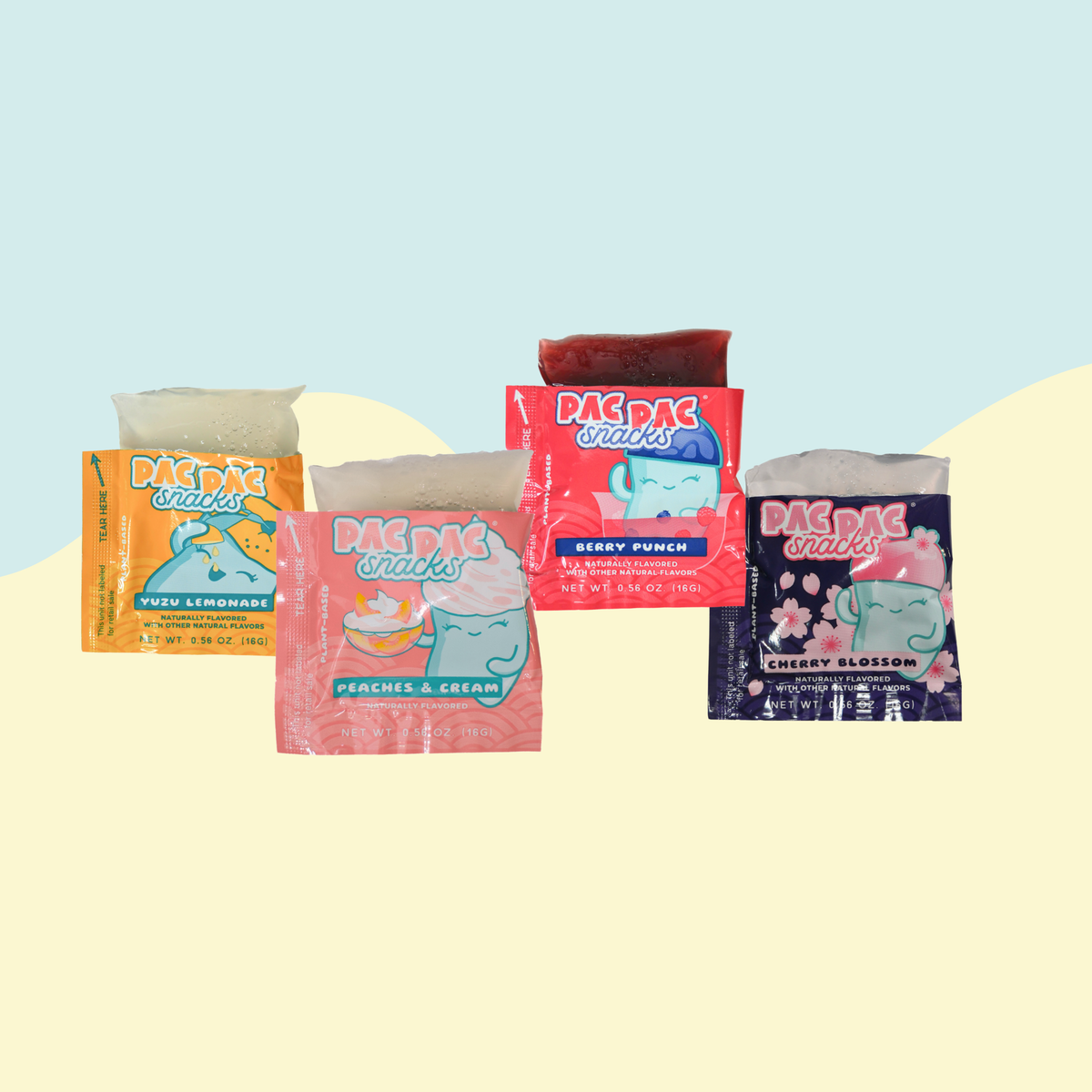
That's the situation with us right now. Our four newer flavors — Yuzu Lemonade, Berry Punch, Peaches & Cream, and Cherry Blossom — are made without artificial flavors. Our older Mango and Matcha recipes still use artificial flavoring while we work on reformulating them.
So if artificial flavor matters to you, read the ingredient list for the flavor you're buying.
Criterion 3 — How is it packaged?
This is easy to overlook, but the package tells you a lot about the product.
“Konjac jelly” can refer to several different formats. A drinkable pouch, a firm jelly cup, and a soft chewable sachet may all use konjac, but they're meant to be eaten in different ways. The difference matters for both texture and, in the case of firm cups, safety.
| Format | Texture | How you eat it | Typical calories | What to know |
|---|---|---|---|---|
| Drinkable squeeze pouch | Soft, pourable gel | Sip through a nozzle | ~4–10 calories | More like a drink than a candy |
| Firm sealed mini-cup | Firm gel | Swallow from the cup | Varies | The format associated with past choking concerns |
| Tear-open chewable sachet | Soft, springy gel | Bite and chew | Low per sachet | Made to be eaten as a chew |
Drinkable pouches
The drinkable squeeze pouch is common in Asian grocery stores. It's a soft gel that you squeeze or sip, and these products are often around 4 to 10 calories per pouch.
If you want a drinkable jelly, that's the format to look for. If you're expecting something you can bite and chew like candy, choose a different package.
Firm mini-cups
This is the format behind konjac jelly's choking history.
In 2001, the FDA issued choking warnings about konjac gel candy following choking deaths involving children.
The concern was the combination of the firm gel and the small cup. The candy could be sucked out as one piece, and its size and shape made it difficult to dislodge if it became lodged in the throat.
The FDA still has an import alert for firm mini-cup gel and jelly candies, and recalls of these products continue to occur.
The important distinction is that these warnings concern the physical format: a firm jelly in a small cup that is designed to be sucked out whole. They aren't a warning about every product that contains konjac.
Tear-open sachets
This is the format we use.
You tear open the sachet and bite into the jelly. It's soft and springy rather than a firm piece designed to be swallowed from a cup.
That makes it a different product from the mini-cup jelly behind the FDA warnings. Two products can both say “konjac jelly” on the package and still have very different textures, formats, and eating instructions.
Criterion 4 — Where does the konjac come from?
This is probably the hardest thing for a shopper to check because the answer often isn't printed on the package.
Konjac is grown in different places, and the properties of the finished flour can vary with the plant and growing conditions. Research has found that glucomannan's molecular weight and gel properties vary by species and growing region.
Before konjac becomes the ingredient in a jelly, the corm goes through several steps: harvesting, cleaning and peeling, drying, and milling into konjac flour.
That's why we think sourcing is worth asking about. A company doesn't need to give you a farm address, but a country or region and some information about how the ingredient is processed gives you more to work with than a vague “made with konjac.”
Our konjac is grown in Japan, and our chews are made in Japan.
Is konjac jelly good for you?
We'd call it a lighter candy. That's about as far as we'd take it.
Konjac jelly products often have single-digit calories to around 15 calories per serving, with zero to a few grams of sugar. A typical gummy has considerably more.
Konjac root is also naturally rich in glucomannan, a soluble fiber. That's a fact about the ingredient, not a reason to treat a piece of candy like a supplement.
We think there's a useful middle ground: konjac jelly can be a lighter choice when you want something sweet without turning the candy aisle into a health-food aisle.
If you want the longer answer, is konjac candy healthy covers the health claims in more detail. We also compare the two formats directly in konjac candy vs. gelatin gummies.
So, what about our chews?
We've spent the whole article telling you what to look for, so it seems fair to turn the bag around on ourselves.
Start with the sugar. We use beet sugar, not sugar alcohols, so you'll see a few grams of sugar on the nutrition panel. No clever “0g sugar” math. It's candy, and we'd rather tell you what's in it.
The flavors are a little more complicated. Our four newer flavors — Yuzu Lemonade, Berry Punch, Peaches & Cream, and Cherry Blossom — are made without artificial flavors. Mango and Matcha are older recipes, and they still use a small bit of artificial flavoring. We're reformulating those and can't wait to put them on your shelf this fall, but they're not there yet.
Then there's the part we care about most: the chew. Our jelly comes in a tear-open sachet, so you bite into it rather than squeeze it through a nozzle or swallow it from a little cup. It's soft, springy, and comes in at about 15 calories per sachet.
And where does the konjac come from? Japan. Our konjac is grown there, and our chews are made there, too. We don't have a single farm to point you toward, so we're not going to pretend we do.
That's the whole picture. If you want to see the flavors and read the labels for yourself, they're all on our konjac chews page.
We think it's a good candy. We also think you should know what's in the bag before you decide for yourself.


