


· By Cullen Mo
Konjac vs. Konnyaku: Are They the Same Thing?
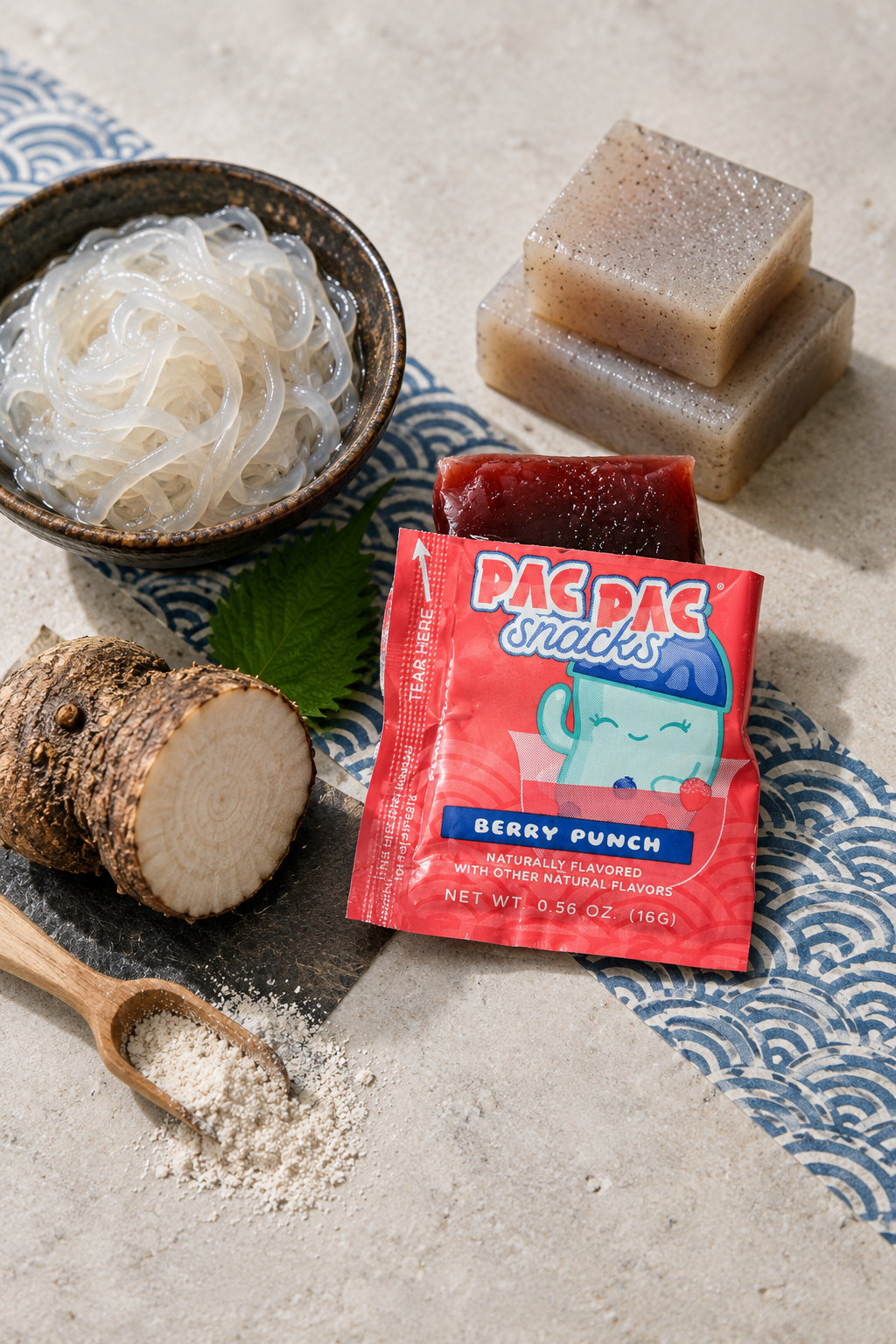
A menu says konnyaku. A bag of jelly chews says konjac. Both are correct. They come from the same plant and, at their core, the same glucomannan fiber. The difference is mostly in how the words are used: konnyaku is the Japanese name for the food, while konjac is the English name borrowed from the plant's scientific name. In Japan, konnyaku usually refers to the firm blocks used in savory dishes. In English, konjac has become the broader term, covering everything from noodles and blocks to jelly candy.
Where do the names konjac and konnyaku come from?
Konnyaku is the Japanese word for the food. Konjac comes from the plant's scientific name, Amorphophallus konjac, which is why the two names look and sound so different. English adopted the scientific name rather than a direct spelling of the Japanese word.
The plant itself has a much longer history. Konjac has been used as food in Japan for centuries, after making its way there from China. The history of konjac in Japan goes deeper into how it became part of Japanese cooking.
What are the different forms of konjac?
The easiest way to understand konjac is to look at what happens after the corm is ground into flour. The resulting glucomannan fiber can be turned into several very different foods.
Konnyaku blocks
Konnyaku blocks are probably the form most familiar to anyone who shops for Japanese ingredients. They're firm, dense, and slightly springy, and are usually simmered in broth or added to dishes such as oden and nimono. Because konnyaku itself has a fairly mild flavor, it takes on the flavors around it.
You'll often see both gray and white konnyaku. Gray konnyaku traditionally gets its darker color and more pronounced flavor from seaweed powder. White konnyaku is made from more refined konjac flour and has a cleaner, milder appearance and flavor.
Shirataki noodles
Shirataki are the noodle-shaped version of konnyaku. They're thin, translucent strands with the same springy texture as konnyaku blocks, but their shape makes them useful in soups, hot pots, stir-fries, and other dishes where a block wouldn't make much sense.
So while konnyaku can refer to the general food or the familiar block, shirataki specifically refers to the noodle form.
Konjac jelly candy
Konjac jelly is the sweet side of the family. It uses the same glucomannan fiber found in konnyaku and shirataki, but instead of becoming a savory block or noodle, the mixture is formulated into a softer, springier jelly and flavored with fruit or other sweet flavors.
Konjac jelly candy has been sold in Japan since 1979. Unlike traditional konnyaku, which is prepared as a savory ingredient, jelly candy is made to eat on its own and is sweetened rather than seasoned for cooking. Our guide to konjac candy explains more about how that chewy texture comes together.
Konjac flour
Before it becomes a block, noodle, or candy, konjac starts as flour. The corm of the konjac plant is dried and ground into a flour rich in glucomannan, a water-soluble fiber. When that flour is mixed with water, it forms a gel. From there, the preparation and ingredients determine what the final food looks and tastes like.
Konjac vs. konnyaku: How can you tell them apart?
If you're standing in a Japanese grocery store or looking at a menu, here's the simple version:
- Firm blocks: usually called konnyaku.
- Thin, translucent noodles: shirataki.
- Sweet, chewy jelly: konjac jelly or konjac candy.
- Ground ingredient: konjac flour.
They're different foods, but they all trace back to the same plant and its glucomannan-rich corm. The biggest difference is what happens after the konjac flour is mixed with water and how the resulting gel is prepared.
Pac Pac's chews use that same konjac root in a sweet, snackable form. They're made in Nagoya and sweetened with beet sugar rather than the corn syrup and sugar alcohols commonly used in jelly candy. See the konjac chews if you want to try the candy version for yourself.


