


· By Cullen Mo
Corn Syrup vs. Beet Sugar: Which One Should You Choose?
Corn syrup and beet sugar both show up on candy labels, and the internet can't agree on whether the difference matters. Type "dangers of high fructose corn syrup" into Google and the first page reads like a public health warning: liver damage, diabetes, an ingredient food companies supposedly can't be trusted with. Type "is HFCS actually dangerous" and the second page tells you to relax, that it's chemically identical to sugar and the whole panic is media noise. Both pages cite research. Neither cites the same numbers.
What HFCS is
High-fructose corn syrup is corn starch processed into glucose, then treated with enzymes that convert some of that glucose into fructose. The two most common commercial versions are HFCS-55 (about 55% fructose, 42% glucose, used in most sodas) and HFCS-42 (about 42% fructose, 53% glucose, used in baked goods and processed foods). Table sugar, or sucrose, is 50% fructose and 50% glucose, but bonded together into a single molecule that stomach acid has to break apart during digestion. HFCS arrives already split. The FDA's own comparison confirms the ratios: HFCS-55 runs about 5 percentage points higher in fructose than sucrose, HFCS-42 about 8 points lower. Neither is a dramatic departure from the 50:50 baseline. It exists in the food supply for reasons that have nothing to do with taste or nutrition: it's liquid, so it skips a dissolving step; it resists crystallizing in soda; it holds moisture in baked goods; and it's historically been cheaper to produce in the US than cane or beet sugar, partly a function of corn subsidies and sugar import quotas.
What beet sugar is
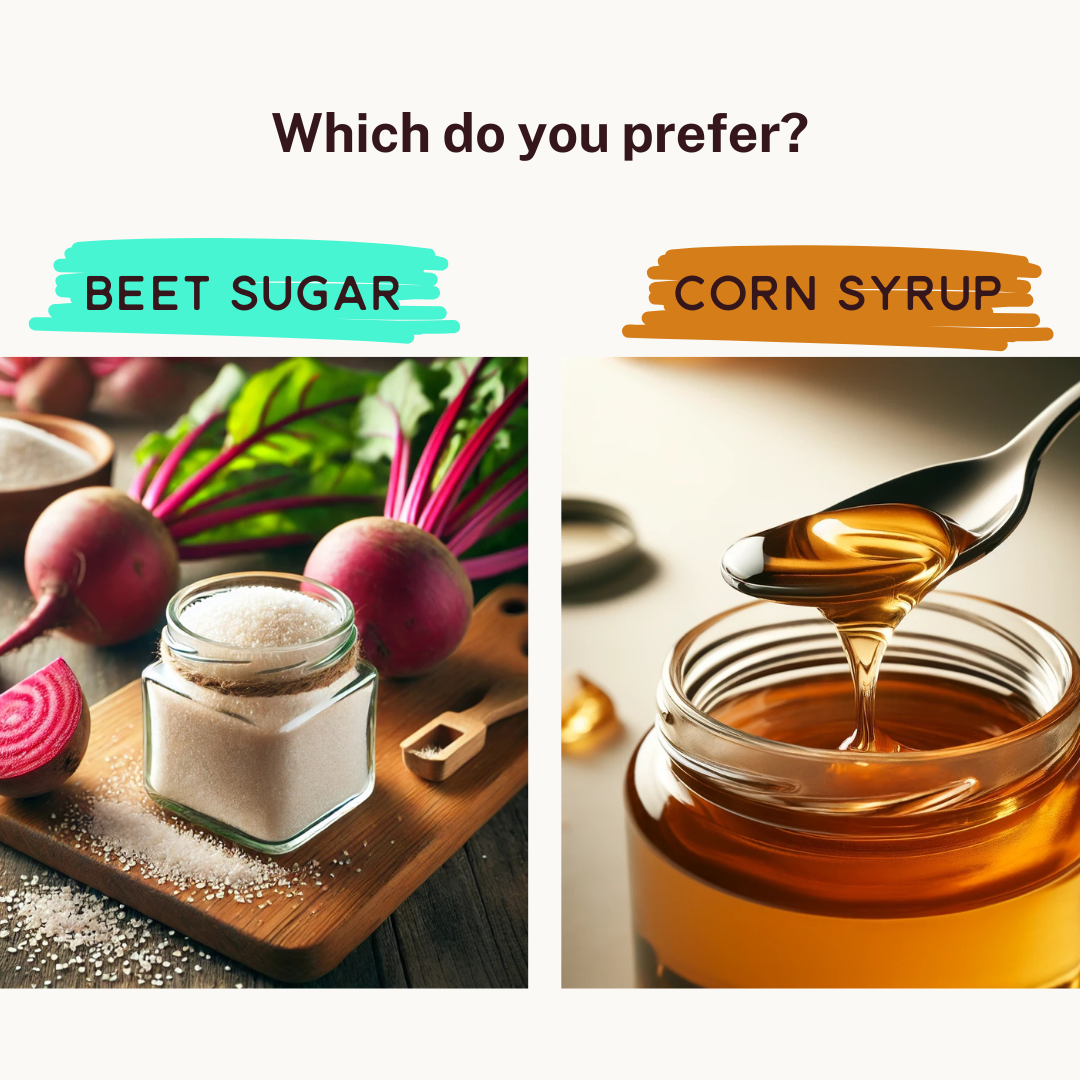
Beet sugar is sucrose pulled out of sugar beets. It's the same molecule as cane sugar, 50% glucose and 50% fructose bonded together, so once it's in a recipe it behaves like any other table sugar. It's naturally gluten-free. (New to the jelly side of this? Start with what konjac candy is.)
Where the real research lands
The FDA has said directly that it's "not aware of any evidence" that HFCS is less safe than sucrose, honey, or other sweeteners with a comparable glucose-fructose split. That's the regulatory answer. The metabolic answer is more specific than either camp online admits.
Fructose is metabolized almost entirely in the liver. It enters liver cells through a transporter called GLUT2 and gets phosphorylated by an enzyme called fructokinase, a step that isn't regulated by insulin, unlike the first step of glucose metabolism. Unrestrained fructose entry drives de novo lipogenesis, the liver's process for building new fat from scratch, by activating a set of fat-synthesis enzymes that glucose doesn't touch the same way. A 2018 dose-response study in the American Journal of Physiology-Endocrinology and Metabolism gave healthy adults escalating doses of fructose and found the liver's fat-synthesis response scaled with the dose. Higher hepatic fat synthesis from fructose is associated with liver fat accumulation and increased risk of non-alcoholic fatty liver disease. Research treats it as one contributing factor to that risk, alongside diet quality, body weight, and genetics.
Zoom out to added sugar generally and the associations get broader, and per CDC's own guidance they're still stated as associations rather than proven causes: high added-sugar intake correlates with weight gain, type 2 diabetes, and heart disease. The 2020–2025 Dietary Guidelines for Americans put a number on it: added sugars under 10% of daily calories, which works out to about 200 calories, or roughly 12 teaspoons, on a 2,000-calorie diet. Children under two shouldn't have any added sugar at all. Neither the CDC nor the USDA singles out HFCS in that guidance. The ceiling is written for added sugar as a category, source unspecified.
Where the mechanism and the trials disagree
The mechanism above is specific to fructose and well documented. But a 2022 systematic review and meta-analysis in Frontiers in Nutrition compared HFCS directly against sucrose, not against a no-sugar control, across anthropometric and metabolic outcomes and found "little differences" between the two. One exception: HFCS was linked to a higher level of C-reactive protein, an inflammation marker, than sucrose. The biochemistry says fructose should behave differently from glucose. The outcome trials mostly say it doesn't, except on that one marker.
What that leaves is added sugar and total fructose load as the real variable. HFCS carries more of that volume because it's cheap and functionally versatile: it shows up in soda, cereal, bread, salad dressing, flavored yogurt, and barbecue sauce, foods a lot of people don't count as "sweets." Someone can clear the day's added-sugar ceiling without eating a single piece of candy. Which sweetener ends up in a product usually comes down to cost and how tightly a manufacturer can control the sugar count per serving. The last section below walks through how that tradeoff played out for us.
The number that matters
Forget the ingredient name for a second and look at the volume. The Dietary Guidelines put the ceiling at roughly 12 teaspoons of added sugar a day on a 2,000-calorie diet. The American Heart Association's own recommendation is tighter: about 6 teaspoons a day for women, 9 for men, though the AHA notes those thresholds aren't based on randomized controlled trials, so treat them as a reasonable target rather than a hard line. A single 12-ounce soda sweetened with HFCS-55 runs about 10 teaspoons of sugar on its own. One can gets a woman most of the way to her daily ceiling before breakfast is even a consideration.
Where Pac Pac lands on this
Pac Pac's chews use beet sugar instead of a corn syrup blend. When the Nagoya co-manufacturer scoped the batch, corn syrup blends were the cheaper, more available option; beet sugar cost more and meant sourcing a separate ingredient stream. A liquid syrup is measured by pour, and pour varies batch to batch. A few extra milliliters and the sugar count on the label is off. Beet sugar goes in as a weighed, discrete ingredient, so the same gram count lands in every chew. That's the same logic behind the switch generally. The konjac chews carry that fixed count forward, chew to chew. If sugar alcohols are the sweetener you're weighing instead, here's why they give some people a stomach ache.
FAQ
Is beet sugar healthier than corn syrup?
Not in any way the research shows. Both are added sugar, and the FDA finds no safety difference between HFCS and sucrose at comparable fructose-glucose ratios. Beet sugar's advantage for us is practical: it's weighed, not poured, so the sugar count per chew stays exact.
What's wrong with high fructose corn syrup?
Nothing uniquely wrong with it as a substance. The FDA has stated it finds no safety difference between HFCS and sucrose at comparable fructose-glucose ratios. The research-backed concern is added sugar intake broadly, which HFCS delivers in large volume because it's cheap and shows up in a wide range of processed foods.
Are the effects of high fructose corn syrup different from regular sugar?
A 2022 meta-analysis comparing HFCS directly to sucrose found little difference in most metabolic and anthropometric outcomes, aside from HFCS being associated with higher C-reactive protein, an inflammation marker. The compositional gap between the two (55% vs. 50% fructose in the most common commercial form) is real but small.
Does high fructose corn syrup cause fatty liver disease?
Research shows fructose, from HFCS or any source, drives a liver process called de novo lipogenesis that's associated with liver fat accumulation and increased risk of non-alcoholic fatty liver disease. Research calls this an association and a contributing factor. It applies to fructose intake generally, not to HFCS specifically as a distinct substance.
How much high fructose corn syrup is safe to eat?
Guidance doesn't set an HFCS-specific limit. It sets one for added sugar overall. The Dietary Guidelines for Americans recommend under 10% of daily calories from added sugar, about 12 teaspoons on a 2,000-calorie diet. The AHA's tighter suggestion is roughly 6 teaspoons for women and 9 for men per day.
See all six Pac Pac konjac chews, or browse all konjac recipes and ideas.


