


· By Cullen Mo
Is Konjac Candy Healthy? What the Fiber Does
Is Konjac Candy Healthy? Why the Gel Matters More Than the Grams
Mostly yes, with a little more background info about what you're buying.
Konjac candy is naturally low in calories, made with dietary fiber, and Pac Pac uses real sugar instead of sugar alcohols. But it's still candy. One chew won't heal your gut, and it won't replace a dedicated fiber supplement.
What is worth looking at is the special gel composition of konjac. Pick up a fiber gummy and there's a big number on the package. One popular brand's gummies list 5 grams of prebiotic fiber per serving, from fructo-oligosaccharides, a form of chicory inulin. But his number doesn't explain how the fiber behaves when digested.
Konjac jelly is made from glucomannan, a soluble fiber from the konjac root. Unlike a typical gummy, where fiber is added to a separate candy base, glucomannan makes the konjac jelly firm. The fiber creates the scaffolding and structure of the candy.
Gel is fiber
Glucomannan is one of the more viscous dietary fibers. It absorbs water and forms a thick gel. Powdered glucomannan does this after you swallow it, as it meets water in the stomach and hydrates. With konjac jelly, the gel is already there when you eat it.
A 2017 randomized crossover trial in the British Journal of Nutrition tested pre-gelled konjac glucomannan noodles — shirataki, roughly 97% water — as a meal preload against pasta (Au-Yeung et al., 2017). Swapping half the pasta for gelled glucomannan cut energy intake by 23%. A full swap cut it 47%, and dessert intake didn't rebound to make up the difference. The fully swapped group did report more hunger later than the control group. The gel takes up space and displaces calories.
Other research supports this finding. The hydration and viscosity of glucomannan seem to matter: more hydrated, more viscous forms can slow gastric emptying and intestinal transit and affect satiety hormones such as GLP-1 (Food Hydrocolloids; J. Agric. Food Chem.).
A trial using 5 grams of a high-viscosity fiber powder blend containing glucomannan found no meaningful change in satiety, yet reduced intake by about 100 calories at 90 minutes (summary).

A note about the old mini-cup candies
Konjac also has a less pleasant chapter in its history.
In the early 2000s, small "mini-cup" konjac gel candies were linked to choking deaths — including six children in the US and elderly victims — leading to FDA warnings and recalls in 2002 (FDA enforcement archive). The problem was the format and the gel's physical properties. The candies were firm, cohesive, and slippery, and they didn't break up or melt easily in the mouth and throat (FDA seizure record, CFSAN 2002).
The same firm gel that gives konjac its texture has important implications for the shape and serving format to ensure safety. The recalled mini-cups could be sucked whole into the throat. Newer squeezable formats are designed differently to avoid this risk. Format determines safety, and konjac itself isn't inherently dangerous. Our full konjac safety history covers the regulations and recalls in detail.

Dosage matters
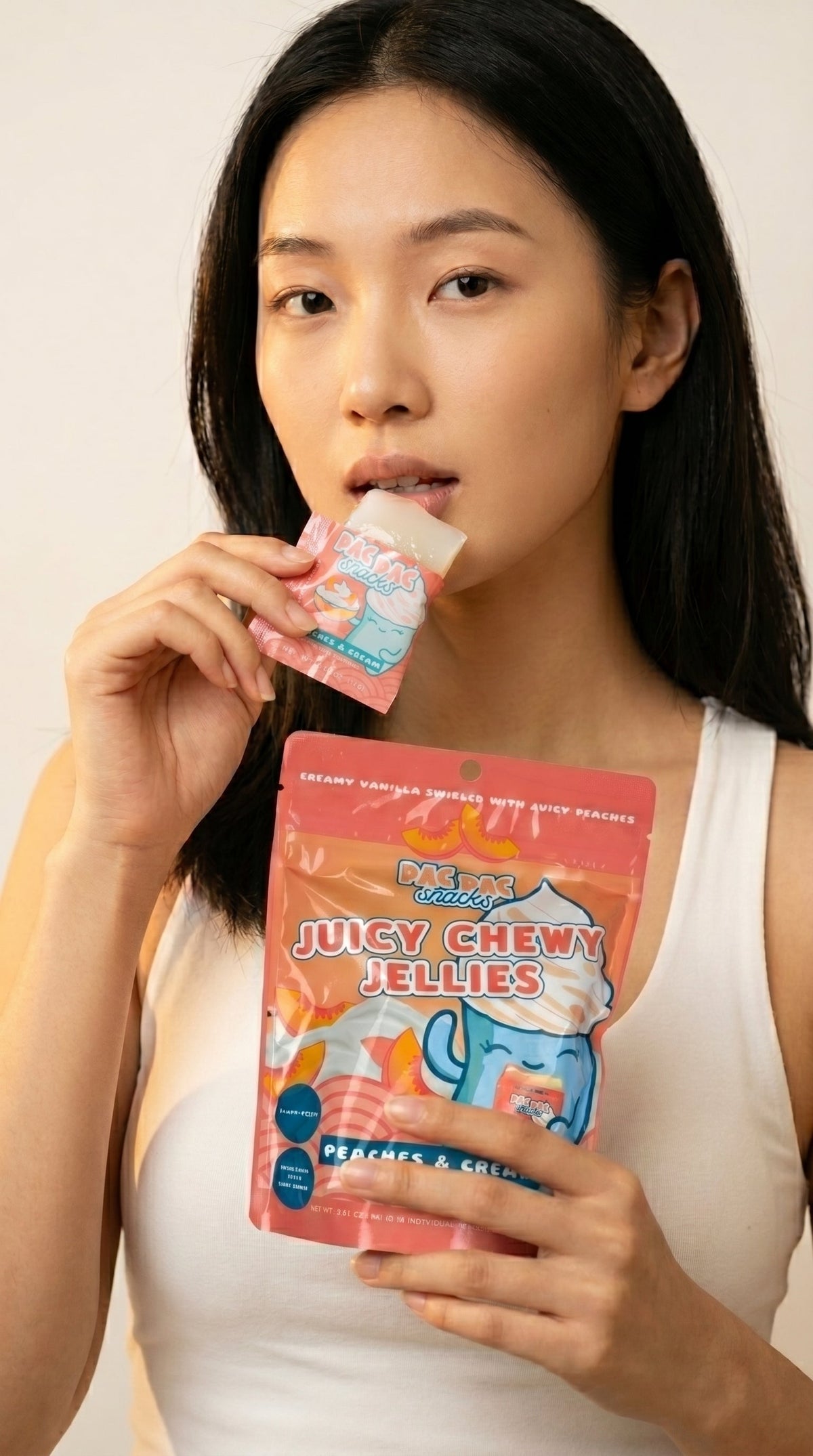
Pac Pac Konjac Chews contain 0.6 grams of fiber per serving, with 15 to 20 calories and 4 to 5 grams of sugar, according to trade coverage of the product.
Clinical trials looking at glucomannan for cholesterol, weight, and satiety use around 2 to 4 grams a day, split into multiple doses (Keithley & Swanson; PubMed). So a single serving of Pac Pac is well below the amounts used in those studies. Pac Pac chews contain rich-in-fiber konjac root, they are not a glucomannan supplement in candy form.
The EFSA record makes the distinction even clearer. Europe authorized two specific health claims for glucomannan, and both have dose requirements. The cholesterol claim requires 4 grams a day (Regulation 432/2012). The weight-loss claim requires at least 3 grams a day, split into three doses of at least 1 gram each, taken with water before meals and as part of a calorie-restricted diet (EFSA Journal 2010). A single chew doesn't meet those thresholds.
EFSA also evaluated claims about maintaining normal bowel function and decreasing gut pathogens in the same 2010 opinion and did not substantiate them. The evidence for specific glucomannan claims is much narrower than the broad "gut health" language you often see on fiber products.
Human microbiome research is more limited. One human trial using 1.5 grams a day for 21 days reported increases in fecal Lactobacillus and Bifidobacterium counts (reviewed here).
A Pac Pac chew contains 0.6 grams of fiber, so it doesn't match that study's dose. It still counts toward your fiber intake. It just isn't evidence that one chew will change your microbiome.
What added-fiber candy does differently
Inulin gummies take a different route. The fiber is added to a separate candy base, and the amount can be much higher. OLLY's version contains 5 grams per serving — roughly eight times what a Pac Pac chew has.
More fiber isn't automatically better for everyone. FOS is rapidly fermented, and larger amounts can cause gas and bloating. A controlled GI-tolerance study found that 10 grams a day of oligofructose increased GI symptoms, with some effects showing up at lower doses (Bonnema et al.; summary).
Inulin and oligofructose also ferment differently from glucomannan, producing different short-chain fatty acid patterns (Timm et al.; Connolly et al.). That's one reason two candies with the same fiber number can feel very different in your stomach.
Then there are sugar alcohols. Sorbitol and maltitol are common in sugar-free candy because they can reduce sugar and calories. They're also well known for causing digestive trouble when you get enough of them. Sorbitol's effective laxative dose starts around 0.4 g/kg body weight in men, with lower thresholds reported in women. Maltitol is generally tolerated at higher amounts, but sensitive people can notice effects at lower doses (Oku et al.; polyol review). More on why sugar alcohols give some people a stomach ache.
Pac Pac uses real sugar instead of sugar alcohols. While there is some sugar, you avoid adding a large dose of potentially irritating polyols to make the candy sugar-free.
Want to try it yourself? Our konjac chews come in six flavors, each made with rich-in-fiber konjac root.
How to read any fiber-candy label
-
Find the fiber source. Is the fiber part of the food itself, or was a separate fiber powder added to the candy base? They're different forms of fiber and don't necessarily behave the same way.
-
Look at the sweetener. Real sugar, sugar alcohols, and other sweeteners come with different tradeoffs. "Sugar-free" doesn't automatically mean easier on your stomach.
-
Compare the dose with the evidence. If a product is talking about a clinical benefit that required several grams of glucomannan, check how much the serving actually contains.
-
Keep the category in mind. A 0.6-gram-fiber chew is a snack. It can contribute to your daily fiber intake without pretending to be a supplement.


