


· By Cullen Mo
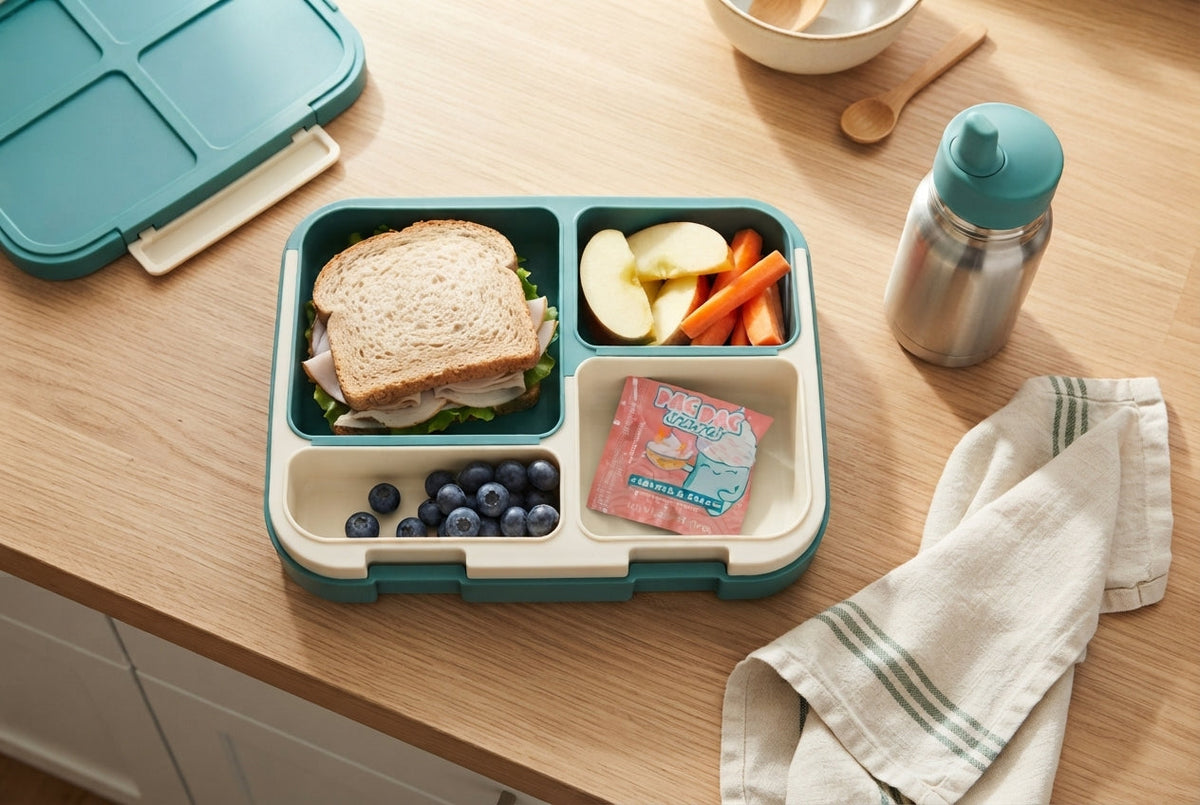
The Lunchbox Treat Slot: What Survives the Backpack
Every lunchbox has a hierarchy.
The sandwich is lunch. The fruit is what you hope gets eaten. The vegetables may come home untouched. Then there's the treat, tucked into some small corner of the bag, waiting to be discovered.
Kids know exactly which part matters most.
For parents, though, a lunchbox treat has a few requirements of its own. It needs to survive several hours without refrigeration. It needs to work with the school's allergy rules. And it has to feel enough like a treat that your kid doesn't immediately start negotiating with the person sitting across from them.
That's a surprisingly short list, but it rules out a lot of familiar snacks.
A homemade cookie can get crushed. Chocolate can melt. A soft gummy can turn sticky in a warm backpack. Fruit needs refrigeration if it's been cut, and even then, a container of sliced strawberries has a way of leaking at precisely the wrong moment.
Pac Pac chews have a simpler job. They're shelf-stable, individually wrapped, and small enough to disappear into a lunchbox. They're also candy, so there's no need to dress them up as something else. A 15 to 20-calorie chew with 4 to 5 grams of sugar belongs in the treat category. The appeal is how easily it fits there.
The backpack test
The first question is a practical one: What will this snack look like at lunchtime?
A gummy can be perfectly pleasant at breakfast and considerably less appealing after several hours in a warm backpack. Heat softens gelatin-based candy, and the pieces can turn tacky enough to stick to their wrappers or to each other. If the backpack spends the afternoon in a hot car, things get worse.
Pac Pac uses konjac gel, which behaves differently when heated. Konjac glucomannan forms a thermo-irreversible gel, meaning it holds its structure rather than melting and setting again like gelatin. The FDA's documentation on konjac glucomannan describes the gel as stable at room and body temperatures.
Pac Pac doesn't publish a maximum storage temperature, so there's no reason to promise that a pouch left on a car dashboard all afternoon will come out looking untouched. The more useful takeaway is that the gel itself holds together under ordinary warm conditions. Each chew also comes in its own tear-and-squeeze sachet, so you aren't carrying six loose pieces of candy around in a bag.
For a lunchbox, that's a pretty good combination: small, sealed, and unlikely to turn into one large gummy.
Then the school rules enter the picture
The other challenge has nothing to do with the snack itself. It has to do with the classroom.
Food-allergy policies vary widely. Some schools ban peanuts and tree nuts. Some have restrictions on outside food. Some classrooms have individual rules because a student has a serious allergy. The note from the teacher matters more than any claim printed on a package.
Food Allergy Research & Education estimates that about one in 13 children has a food allergy, based on a 2015–16 survey of more than 38,000 children. A 2021 CDC survey put the number closer to one in 17. Either way, food allergies are common enough that checking the classroom rules should be part of packing lunch.
Pac Pac chews are vegan and gluten-free across the current lineup. That covers dairy, eggs, and gluten, but vegan does not mean nut-free. Pac Pac's ingredient panels are published as label images rather than searchable text, and there is no separate nut-free or soy-free claim to rely on.
If the classroom has a strict nut-free policy, check the package and the school's rules before packing them.
A note about konjac candy and choking
If you've searched for konjac candy before, you may have run into some alarming stories about the FDA and choking hazards. There's a real history behind those warnings, but the format of the candy is an important part of the story.
In 2001, the FDA issued warnings about mini-cup gel candies and later published Import Alert 33-15, which halted imports of that format. These were small, sealed cups of firm gel candy designed to be sucked out whole. Because the gel stayed firm in the mouth, a piece could lodge in a child's airway.
Pac Pac uses individually wrapped sachets instead. You tear open the package and squeeze out the chew rather than sucking a piece from a sealed cup.
Young children still need the usual supervision for firm, chewy foods. Have them sit down, chew thoroughly, and take their time. The same basic advice applies to other foods with choking risks, including grapes, hot dogs, and hard candy.
If konjac is new to you, our guide to what konjac candy is covers the ingredient itself first.
So where does a Pac Pac chew fit?
Mostly, where you'd expect: in the little treat corner of the lunchbox.
One sachet takes up very little room and doesn't need an ice pack. It's also individually wrapped, so the kid can open one without turning the rest of lunch into a snack pile.
The same qualities make the chews useful for road trips. A bag of loose gummies can become a sticky mess after a few hours in a warm car. Individually wrapped chews are easier to pack, hand out, and put away again.
And then there's the desk drawer. The 3 p.m. candy craving doesn't care whether you're seven years old or sitting in a spreadsheet meeting. A few shelf-stable chews are easy to keep around without taking up much space.
For a small gift, the Classic Flavors 4-Pack includes Mango and Matcha, while the All-Natural Variety 4-Pack includes Peaches & Cream, Yuzu Lemonade, Berry Punch, and Cherry Blossom. They can also be paired with a Pac Pac Pal such as Momeez or Mr. Pinky.
What about the nutrition?
Here's where it's worth keeping the numbers in perspective.
The Classic Flavors pack has 15 calories and 4 grams of sugar per serving. The All-Natural Variety has 20 calories and 5 grams. Both list 0.6 grams of fiber.
Those numbers make sense for a small piece of candy. They don't make the chew a substitute for fruit, vegetables, protein, or any other part of a balanced lunch. The fiber is worth mentioning because it's there, but 0.6 grams isn't enough to call the candy fiber-rich.
That may sound obvious, but food marketing has a habit of turning one favorable number into an entire personality. It's more useful to know what a snack does well and where it stops.
Pac Pac does well as the treat: portable, shelf-stable, individually wrapped, and chewy. That's plenty.
The lunchbox checklist
If you're choosing a treat for a school lunch, a few questions will get you most of the way there:
Will it survive the trip to school?
Think about heat, leaking, melting, and whether the snack will still be recognizable at lunchtime.
Does it fit the classroom rules?
Check the school's allergy and food policies first. Package claims don't override a classroom rule.
Will the kid actually want it?
This one gets overlooked. A snack that comes home every day hasn't solved much.
Is the serving size reasonable?
Look at the actual calories and sugar rather than relying on words like "natural" or "better-for-you."
Does the texture require supervision?
Firm, chewy foods should be eaten slowly by young children.
That's really the lunchbox test. The snack needs to make it through the backpack, pass the classroom rules, and still be something the kid is happy to find at noon.
Pac Pac happens to check those boxes pretty neatly.


